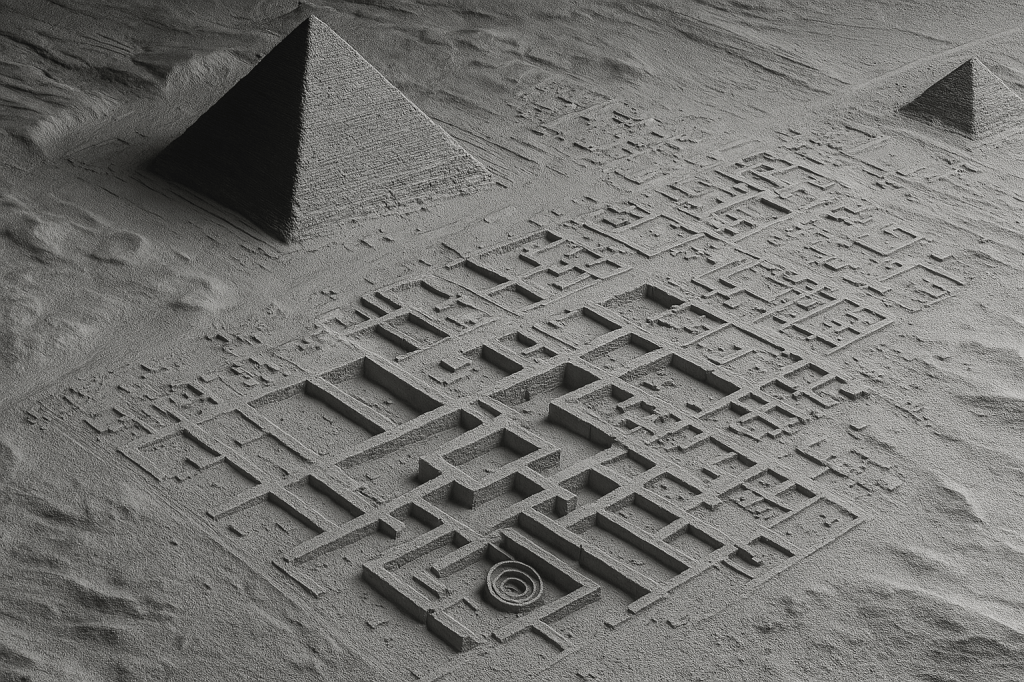
Claims of a Lost Underground City and the Politics of Suppression
Introduction In March 2025, the New York Post published an article. It sparked renewed curiosity—and controversy—about what lies beneath Egypt’s Giza Plateau. According to the report, researchers from Italy and Scotland used Synthetic Aperture Radar (SAR) technology. They detected a vast network of chambers, shafts, and tunnels. These structures extend more than 2,100 feet below the pyramids. If true, this will rank among the most significant archaeological discoveries of the modern era. It rewrites the accepted timeline of ancient Egyptian civilization.
Nonetheless, the claims stay unverified. Egypt’s leading authorities and mainstream archaeologists have dismissed the findings. This prompts a deeper question: Is this rejection rooted purely in science? Or are there political interests at play?
The Discovery: What the Scientists Say The researchers assert that their advanced radar scans revealed:
- Deep vertical shafts,
- Spiral-designed passageways,
- Large, structured chambers,
- Signs of intentional human construction far below current excavation depths.
They also suggest the underground structures are linked to the legendary “Hall of Records.” This is a mythical archive of ancient knowledge. It is often connected with the Great Sphinx.
The scans indicate sheer depth and architectural complexity. They argue that these properties surpass known engineering capabilities of the Old Kingdom era. This raises the possibility of an earlier, undocumented civilization with advanced building skills.
Dismissal by Authorities and Academia Egyptologist Dr. Zahi Hawass responded quickly. He labeled the report as “fake news.” He cast doubt on both the technology used and the credibility of the researchers. The Egyptian Ministry of Antiquities reiterated a key message. They insisted that any discovery on the Giza Plateau must be conducted under official supervision. It must also follow peer-reviewed standards.
No academic journal has published the findings so far. No excavation has been approved. The data remains outside the scope of traditional archaeological consensus.
Why the Pushback? Unpacking the Political Dimension Skepticism is natural in the scientific process. But, the speed and intensity of the denials have led some to question whether political interests are influencing academic decisions. Egypt has strong incentives to control the historical narrative tied to the Giza pyramids:
- Tourism and Economic Interests
- The Giza Plateau is central to Egypt’s tourism industry.
- A radical reinterpretation of its origins could undermine visitor confidence and destabilize the economy reliant on a well-preserved national story.
- National Identity and Cultural Legacy
- Egypt’s modern identity is built on pride in its dynastic heritage.
- Discoveries suggesting pre-dynastic civilizations or foreign influence could challenge this foundational narrative.
- Academic and Institutional Preservation
- Decades of research support the current historical timeline.
- A discovery of this scale would disrupt established scholarship, challenge academic reputations, and require a rewriting of history books.
- Tight Government Control Over Excavation Rights
- The Supreme Council of Antiquities regulates all archaeological activity.
- Foreign teams proposing controversial theories often face denial, restriction, or bureaucratic obstruction.
Conclusion: The Silence Beneath the Sand The concept of a hidden city beneath Giza mixes legend with reality. It blurs the line between these two aspects. There is no concrete, peer-reviewed evidence to confirm the radar findings. Nonetheless, the outright refusal to explore or transparently evaluate them raises valid concerns.
The stakes of rewriting history are high—for governments, institutions, and entire nations. Whether these underground structures are real or imagined, we refuse to investigate. This leaves the truth buried deeper than the sand itself. Until full access and independent verification are allowed, the mystery beneath Giza will remain not only unexplored—but, deliberately ignored.
Sources:
The New York Post
The Sun
A Theory of Earth Energy
Tesla + Pyramid Energy + Ancient Egyptian Symbolism
Nikola Tesla believed that the Earth could serve as a conductor of electrical resonance, using tuned coils and radiant energy to transmit power wirelessly through the ground and air. When we overlay this idea onto the design and symbology of the Great Pyramid, intriguing parallels emerge.
🔺 The Pyramid as a Resonant Structure
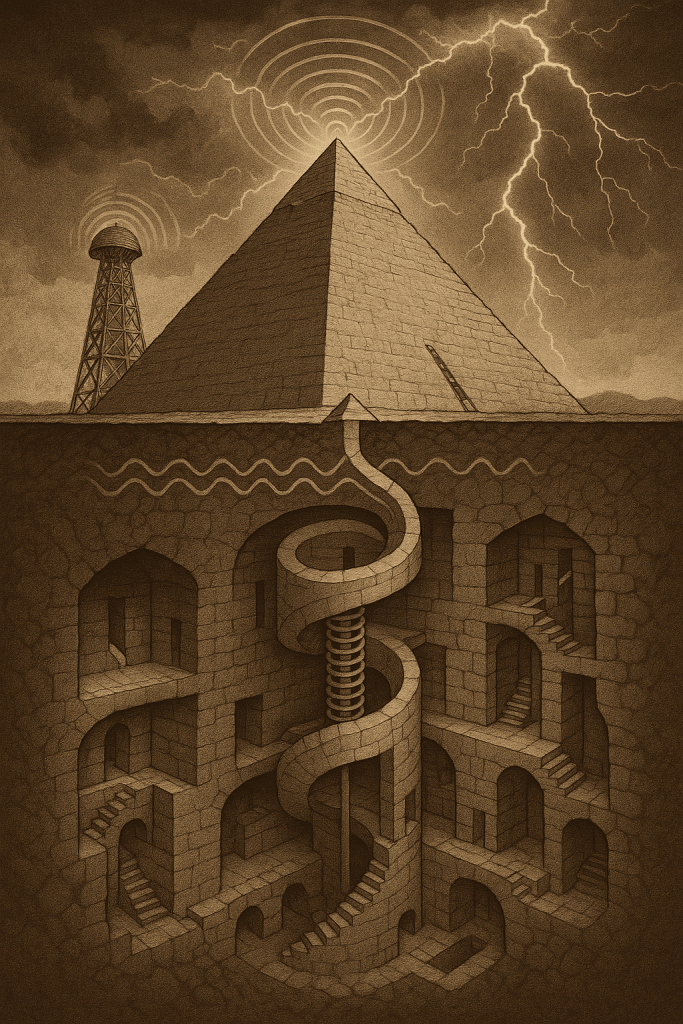
The pyramid shape itself is geometrically tuned. Its angles and alignment with true north suggest a deliberate calibration — as if it were built to resonate with the Earth’s natural frequencies. Tesla’s coils worked best when grounded deep into the Earth and extended into the sky, much like the pyramid rising from bedrock with subterranean chambers and a missing capstone that may once have acted as a conductor or energy focus.
Egyptian Symbolism That May Allude to Energy Use:
1. The Djed Pillar
Often referred to as the “backbone of Osiris,” the Djed pillar appears in temples and tombs. It is strikingly similar to a modern coil or capacitor stack.
- Interpreted literally, it may represent stability or resonant frequency — something standing upright to carry force.
- Metaphorically, it mirrors a Tesla coil, transmitting energy vertically from the earth toward the sky.
2. The Ankh
The Ankh, or symbol of life, has a loop at the top, a crossbar, and a vertical shaft — a shape reminiscent of a tuning fork or energy channel.
- In speculative interpretations, it could represent the circuit of life force, or even a tool to receive energy.
- Many deities are shown using it near the forehead or mouth, suggesting energy transmission or awakening.
3. Bags in the Hands of Gods and Priests
Ancient reliefs and tombs depict gods and high priests holding what appear to be small handheld “bags.”
- These “bags” are carried the same way modern linemen carry battery packs or capacitors.
- In speculative theory, they may be energy collectors or resonance tools, receiving ambient energy from the pyramid or its magnetic field.
4. The Was Scepter
This staff-like symbol is topped with a fork and often appears with the Djed and Ankh.
- Its shape suggests control, channeling, or focus of energy — similar to a wand or tuned conductor.
- It may symbolize authority over forces, or in Tesla’s context, dominion over energetic fields.
5. Hieroglyphic Lightning
In some temple art, zigzag lines (representing lightning or power) flow from one object to another, such as from the sun disc or from the hands of gods to pharaohs.
- This could be symbolic of solar or radiant energy transfer.
- It aligns with Tesla’s idea of energy harvested from the upper atmosphere or the sun’s radiant field.
Uniting the Concepts:
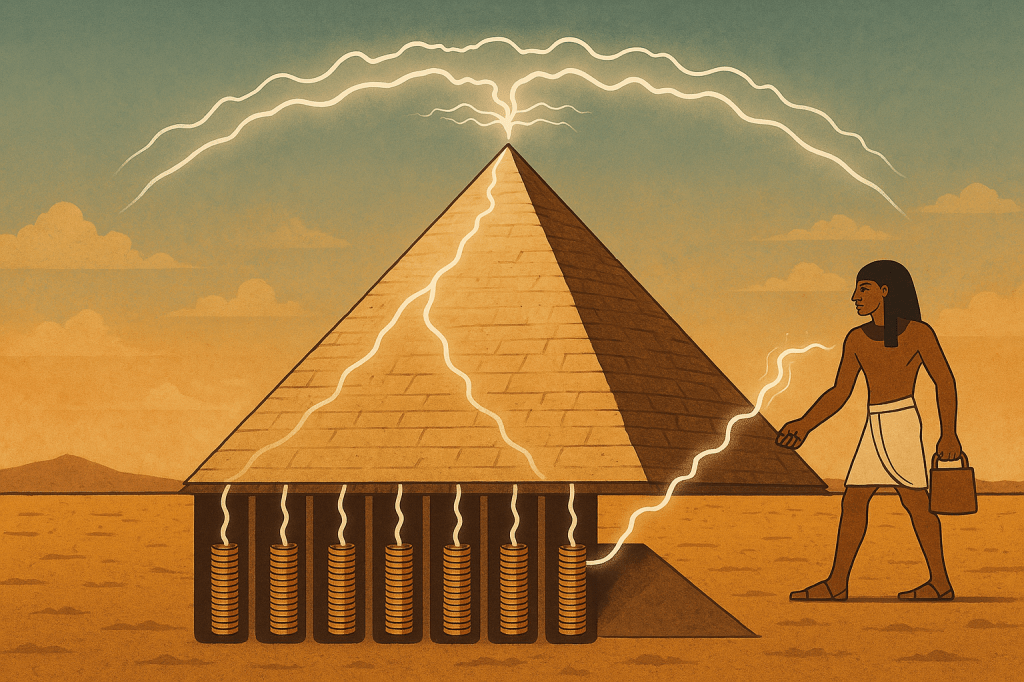
If we consider that the Great Pyramid was more than a tomb — that it was an instrument — then its underground coils (like Tesla’s Earth connection), angled shafts (waveguides), and symbolic engravings (functional blueprints) all point to a civilization that may have understood and harnessed natural energy fields.
In this speculative view:
- The pyramid is the transmitter
- The coils beneath it are tuned to Earth’s frequency
- The capstone is the radiant antenna
- The symbols are not just decorative, but instructive
They didn’t just worship the gods…
They walked with power.



 Hypothetical Thinking
Leave a comment