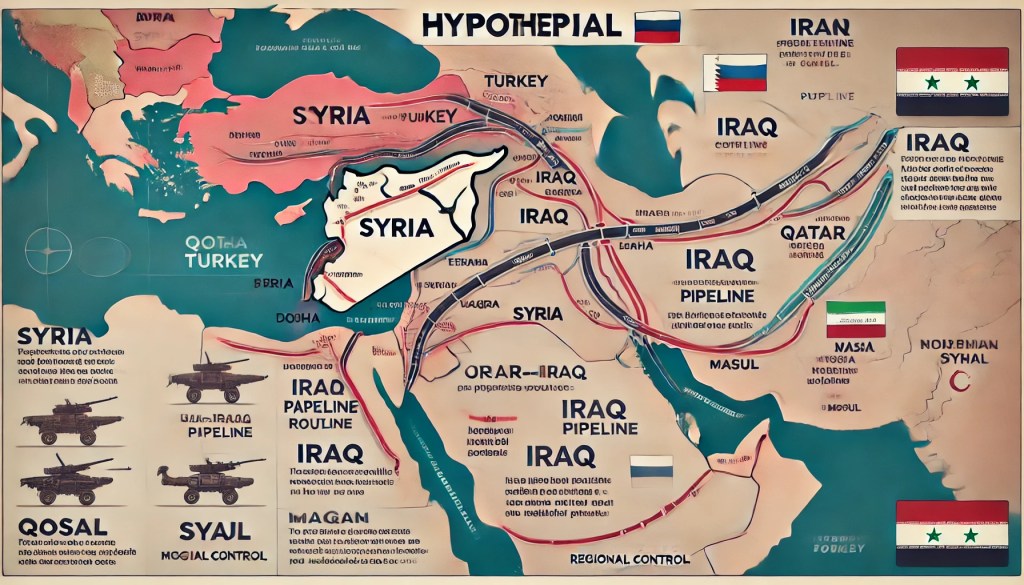
A hypothetical energy war in the Middle East.
Introduction
The conflicts in Syria and the broader Middle East are often framed as struggles against terrorism or civil uprisings. Yet, a deeper examination suggests that geopolitical energy strategies may have been the underlying motivation. This scenario hypothesizes that U.S. and allied actions were not accidental but calculated efforts to destabilize key regions for control of global energy resources, particularly involving the Qatar-Turkey pipeline, the Iran-Iraq-Syria pipeline, and broader plans to counter Russian and Iranian influence.
Timeline of Key Events in the Hypothetical Scenario
1. The War on Terror (Post-9/11 Era)
- After 9/11, the U.S. launched its War on Terror, prioritizing military presence in oil-rich regions like Iraq and Afghanistan.
- 2003 Iraq Invasion:
- Under the pretext of eliminating weapons of mass destruction (WMDs), the U.S. toppled Saddam Hussein. This not only destabilized Iraq but also created a power vacuum that eventually facilitated the rise of ISIS.
- Iraq, sitting atop the world’s second-largest proven oil reserves, became a battleground for energy control.
- Weapons in the Wrong Hands:
- During this time, massive amounts of U.S.-supplied weaponry were left unsecured, many of which would later be used by insurgent groups.
2. The Arab Spring and Syrian Civil War (2011)
- Destabilizing Syria:
- The Arab Spring provided a pretext for the U.S. and its allies to push for regime change in Syria. Assad’s government had rejected the Qatar-Turkey pipeline in favor of a rival Iran-backed route. Removing Assad would clear the path for the U.S.-aligned pipeline.
- Weapons were funneled to Syrian opposition groups under the guise of supporting “moderate rebels.” However, the lack of control allowed extremist factions like Al-Qaeda and ISIS to thrive.
- The CIA’s Role:
- Operations such as Timber Sycamore, a covert CIA program, funneled weapons and funds to Syrian rebels. A 2017 report by the Conflict Armament Research (CAR) found that U.S.-supplied weapons were being used by ISIS, highlighting a direct link between these covert programs and the rise of extremist factions.
3. The Rise of ISIS (2014)
- Power Vacuum and Oil Control:
- ISIS rapidly filled the void left by destabilized regimes in Iraq and Syria. It seized oil fields and refineries, generating millions of dollars in revenue. This served dual purposes:
- Disrupting regional stability to prevent pipeline projects.
- Creating justification for U.S. military operations under the pretext of defeating ISIS.
- Aleppo, located near strategic pipeline routes, became a key battleground. ISIS’s proximity to this city further complicated Syrian control over the area.
- ISIS rapidly filled the void left by destabilized regimes in Iraq and Syria. It seized oil fields and refineries, generating millions of dollars in revenue. This served dual purposes:
- Indirect Support:
- U.S.-supplied vehicles, weapons, and communications gear often fell into ISIS’s hands. Photographs from 2014 show ISIS convoys using U.S.-made Humvees, which were either captured or abandoned by Iraqi forces trained by the U.S.
4. Russian Intervention and the Battle for Aleppo (2015-2016)
- Russia, seeing the strategic importance of Syria for its own energy routes and regional influence, intervened militarily to support Assad.
- The Battle of Aleppo:
- Aleppo’s recapture by Assad’s forces, with Russian support, marked a turning point in the Syrian Civil War. The victory secured a critical segment of the Iran-Iraq-Syria pipeline route, countering U.S. and Gulf state interests.
5. The Afghanistan Withdrawal (2021)
- Taliban’s Weapon Windfall:
- After the U.S. withdrawal, the Taliban seized billions of dollars in U.S. military equipment, including rifles, armored vehicles, and aircraft.
- This bolstered the Taliban’s ability to maintain regional control, complicating potential Chinese and Russian investments in Afghanistan, such as mineral extraction and pipeline projects.
Pipeline Politics and Hypothetical U.S. Motivations
The Qatar-Turkey Pipeline
- Backed by Qatar and Turkey, this pipeline would supply natural gas to Europe, bypassing Russia and Iran. Its success hinged on toppling Assad, who blocked the project in favor of the rival Iran-backed route.
- The U.S. and its allies may have supported insurgencies to weaken Assad’s grip on Syria and create the conditions for a pro-Western government.
The Iran-Iraq-Syria Pipeline
- Supported by Iran, Iraq, and Syria, this pipeline would transport gas to Europe via the Mediterranean, directly competing with the Qatar-Turkey project.
- Destabilizing Syria through insurgencies would hinder this pipeline’s construction, maintaining U.S. influence over global energy flows.
The Latest Developments: Al-Qaeda’s Resurgence in Aleppo
- Reports of Al-Qaeda-affiliated groups resurfacing in Aleppo suggest a renewed struggle for control over the region. This resurgence may be seen as an attempt to reignite instability, ensuring no single power dominates strategic regions crucial for energy transport.
Key Questions and Hypotheses
- Deliberate Destabilization?
- Was the U.S. strategy in Syria and Iraq aimed at long-term destabilization to prevent rivals like Russia, Iran, and China from asserting control over critical energy corridors?
- Empowering Extremists as a Geopolitical Tool?
- Did the U.S. knowingly leave weapons and resources to groups like ISIS and Al-Qaeda to serve broader strategic goals, such as disrupting pipeline projects and maintaining leverage over allies like Saudi Arabia?
- Energy vs. Terrorism:
- Were the wars in the Middle East truly about counter-terrorism, or were they energy wars disguised as ideological conflicts?
Hypothetical Scenario
This hypothetical scenario connects the dots between U.S. actions, insurgent empowerment, and energy politics in the Middle East. By examining events through the lens of pipeline routes and regional control, it becomes clear that destabilization may not have been an unintended consequence but a deliberate strategy. Whether by accident or design, these actions have reshaped the Middle East, ensuring that no single power—neither regional nor global—can dominate its energy resources unopposed.


 Hypothetical Thinking
Leave a comment