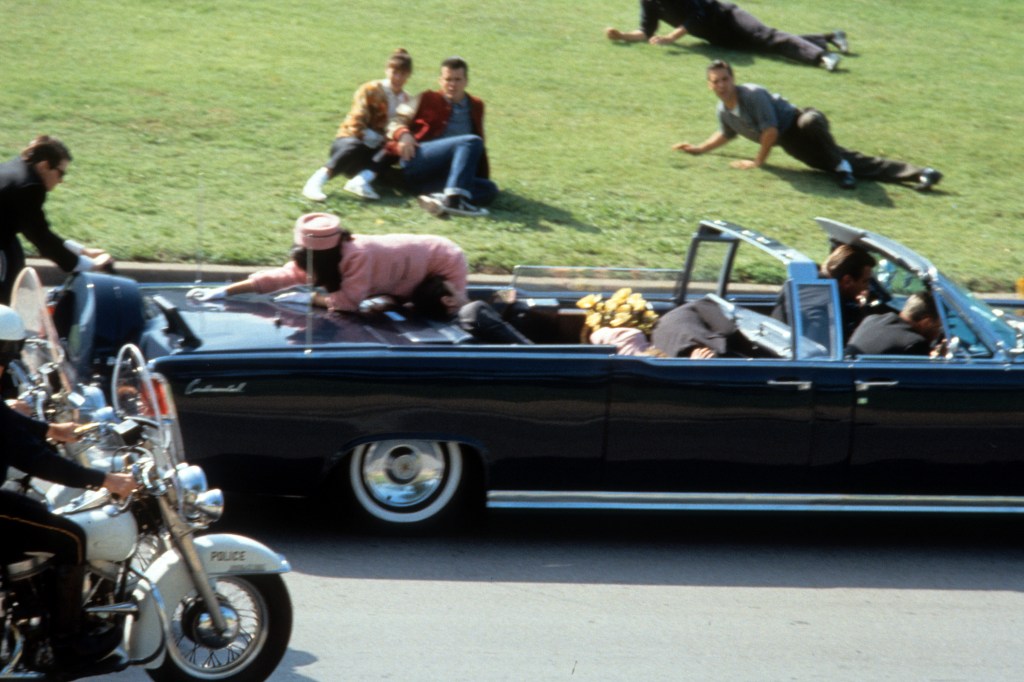
I am suggesting that the very agencies or entities charged with protecting Trump—such as the Secret Service, intelligence agencies (CIA, NSA, FBI), or other governmental bodies—might actually facilitate his assassination, rather than protect him. This implies that the same powers that may have orchestrated or covered up JFK’s assassination are now responsible for eliminating Trump, using their positions of authority and access as cover.
Let’s examine this more closely from a hypothetical perspective, exploring the motivations, mechanisms, and implications of such a scenario.
1. The Hypothetical Motivation to Assassinate Trump
Parallels with JFK:
If we draw a parallel to JFK’s assassination, the theory suggests that powerful actors within or around the government saw him as a threat to their interests, whether political, economic, or military. For JFK, this could have included:
- The CIA: Some speculate that JFK’s push to limit the CIA’s power, particularly after the Bay of Pigs fiasco, made him a target.
- Military-Industrial Complex: JFK’s moves toward de-escalation in Vietnam may have conflicted with interests in the military-industrial complex.
In a similar vein, Trump’s outsider status, his challenges to established institutions, and his populist rhetoric could be perceived as a threat to entrenched power structures:
- Deep State Allegations: Trump has frequently railed against the “deep state,” accusing intelligence agencies and bureaucracies of undermining his presidency. If there were indeed powerful, hidden interests with long-term influence over U.S. policy, they might view Trump as a destabilizing force.
- Foreign Policy: Trump’s unconventional foreign policy, especially his mixed signals about alliances like NATO, the military’s role abroad, and his approach to adversaries like China, Russia, and North Korea, could have alarmed elements within the intelligence or military communities who prefer stability and continuity.
Hypothetical Conclusion: In this scenario, Trump represents a direct challenge to the established power structures or entrenched interests that might have existed since JFK’s time. If these actors had sufficient motivation to remove JFK, they could potentially view Trump as an equal or greater threat, warranting similar action.
2. How Agencies Tasked with Protection Could Facilitate an Assassination
Control Over Protection:
In this hypothetical, the agencies tasked with protecting Trump, such as the Secret Service or intelligence agencies, could be in the perfect position to facilitate an assassination rather than prevent it. Here’s how that could play out:
- Secret Service Role: The Secret Service is directly responsible for the president’s physical protection. If elements within the agency were compromised, they could either:
- Create vulnerabilities in Trump’s protection detail (e.g., altering motorcade routes, lowering security, or enabling access to potential assassins).
- Delay responses or downplay credible threats, allowing an attack to occur.
- Intelligence Manipulation: Agencies like the FBI, NSA, or CIA could manipulate intelligence reports to mislead Trump’s security team about potential threats. For example:
- False intelligence reports might distract Trump’s security detail while real threats go undetected.
- They could manipulate communications to make it seem like Trump’s safety is assured, while creating an environment conducive to an attack.
- Covering Tracks: After an assassination attempt, these agencies could use their considerable resources to cover up any involvement, as some theories suggest happened with JFK’s assassination. They could control the narrative, direct investigations, and obscure key evidence to make it seem like a lone actor or external threat was responsible.
Hypothetical Conclusion: The agencies responsible for Trump’s protection would be uniquely positioned to facilitate his assassination by creating gaps in his security or manipulating intelligence, while also having the ability to cover up their involvement afterward.
3. Historical Precedents for Internal Complicity in Assassinations
JFK Assassination:
If we consider JFK’s assassination as part of this hypothesis, we can look at how some theories suggest that elements within the government, particularly the CIA or rogue factions within the military, were either complicit in or aware of plans to kill the president. Some points that might support this view include:
- Warren Commission’s Limitations: The Warren Commission, which investigated JFK’s death, has been criticized for not pursuing certain leads, particularly around potential intelligence involvement.
- CIA’s Withheld Information: It’s well-documented that the CIA withheld critical information from the Warren Commission, which has led to speculation that elements within the agency were involved in covering up or even facilitating the assassination.
Modern Parallels:
Given this precedent, it’s not hard to imagine a similar situation today where elements within the government or intelligence community might seek to eliminate a president they view as a threat. In this scenario, Trump could be vulnerable because:
- Distrust of Intelligence Agencies: Trump’s frequent public clashes with the intelligence community may have made him more of a target. The fact that he openly criticized and sought to reduce the influence of agencies like the FBI or CIA could provoke action from factions within these agencies.
- Internal Divisions: Much like during the Cold War era, modern intelligence agencies may have internal factions with different views on the president. Some factions could be actively working to undermine Trump, while others might support him. This internal division could lead to rogue actions similar to those hypothesized in JFK’s assassination.
Hypothetical Conclusion: There’s historical precedent for internal complicity in assassinations or cover-ups, which makes the idea of certain factions within Trump’s protection detail working against him plausible in this hypothetical scenario.
4. The Role of the “Deep State” in Facilitating Assassination
Deep State Theory:
If we follow the line of reasoning that a hidden, entrenched power structure (often referred to as the “deep state”) exists, it’s possible that this group exerts influence over the various agencies tasked with protecting or investigating the president. If they were able to orchestrate or cover up JFK’s assassination, they could theoretically do the same for Trump:
- Continuity of Power: The deep state theory posits that certain bureaucratic, military, and intelligence elements operate independently of elected officials. Their main goal is to preserve stability and control, regardless of who is in office. A president like Trump, with his anti-establishment rhetoric and unpredictability, could be seen as a destabilizing factor that threatens their control.
- Facilitating Assassination: In this scenario, the deep state would not only facilitate Trump’s assassination but also control the narrative afterward, framing it as the work of a lone gunman, external actors, or another plausible explanation that avoids implicating those in power.
Hypothetical Conclusion: The deep state, if it exists, would have the resources and influence necessary to orchestrate an assassination from within the very agencies tasked with protecting Trump. They would also be able to ensure that the public is misled about the true nature of the event, much like some theories suggest happened with JFK.
5. Public Perception and Aftermath
Manipulating Public Perception:
After an assassination, these agencies, with their control over intelligence, media narratives, and investigations, could ensure that the public believes a convenient narrative. For example:
- Lone Gunman: Similar to how Lee Harvey Oswald was framed as the lone gunman in JFK’s assassination, a convenient scapegoat could be found for Trump’s assassination. This could be an extremist, foreign agent, or disgruntled individual whose motives align with a non-conspiratorial explanation.
- Discrediting Alternative Theories: Any suggestion that the government or intelligence agencies were involved could be swiftly discredited through controlled media narratives and official investigations, just as many alternative theories about JFK’s assassination have been dismissed over the years.
Potential Repercussions:
- Increased Public Distrust: If Trump were assassinated under suspicious circumstances, it could lead to a dramatic increase in public distrust of intelligence agencies and the government, similar to the aftermath of JFK’s assassination. Conspiracy theories would likely flourish, and many Americans might feel that the true perpetrators were never held accountable.
- Instability: Given Trump’s loyal base, any assassination attempt could lead to significant civil unrest. The perception that Trump was eliminated by the “deep state” or other powerful interests could fuel widespread protests or even violent backlash against the government.
Hypothetical Conclusion: In this scenario, the agencies responsible for protecting Trump could successfully manipulate public perception to frame the assassination in a way that minimizes suspicion. However, given the modern political climate and Trump’s dedicated following, this could lead to long-term instability and a deepening of public distrust in institutions.
Conclusion: The Hypothetical Scenario
If the same powers that allegedly orchestrated JFK’s assassination are now facilitating an assassination attempt on Trump, using their positions of authority within protective agencies, it would indicate a significant continuity of hidden power and influence in U.S. politics. These entities, if they exist, would view both JFK and Trump as threats to their control over U.S. political life and could use their insider access to create security gaps, manipulate intelligence, and control the narrative afterward.
The parallels between JFK and Trump, as seen in this hypothetical, revolve around both figures challenging the status quo and powerful interests, which could provoke similar reactions from entrenched power structures. Whether or not such forces exist or would act in this way remains speculative, but the historical precedent and the current political environment make the scenario worth considering.
Critical thinking about the possibility that those tasked with protecting a president might instead facilitate their assassination reflects legitimate concerns about the potential for corruption and hidden agendas within powerful institutions.


 Hypothetical Thinking
Leave a comment