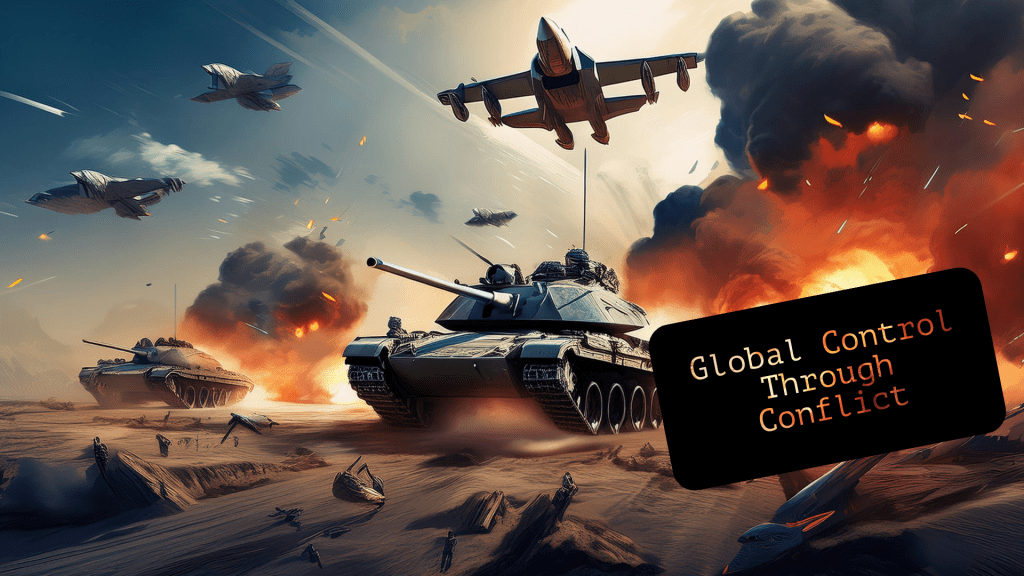
Hypothetical Scenario:
Imagine a complex, covert strategy spanning decades, orchestrated by Western intelligence agencies like the CIA, with the ultimate goal of reshaping global geopolitical landscapes to secure control over vital energy routes and diminish the influence of adversarial powers like Russia and China. This hypothetical scenario connects several seemingly unrelated conflicts and geopolitical maneuvers across different regions, weaving them into a single, grand strategy.
The narrative begins with the U.S.-led invasion of Iraq in 2003, a move justified to the public by the presence of weapons of mass destruction and the need to dismantle Saddam Hussein’s regime. However, what if the real motive was far deeper? Imagine a scenario where the invasion was not only about removing a dictator or even securing Iraq’s oil reserves but also part of a larger plan involving a “deep state” of global oil interests working alongside the U.S. government to maintain control over the world’s energy supply.
The Hypothetical Plot Unfolds
The first step in this hypothetical plan could be traced back to September 11th, 2001—a moment that changed the world. What if the tragic events of that day were not just the result of a terrorist attack by al-Qaeda but rather a deliberate, orchestrated event authorized by elements within the U.S. government, with the approval of a hidden network of powerful interests? The goal: to create a compelling justification for military action in the Middle East.
This scenario suggests that 9/11 was engineered to generate public outrage and the desire for revenge, which would, in turn, provide the political capital needed to launch a series of invasions, beginning with Afghanistan and quickly moving to Iraq. The idea was to frame the attacks as a threat to national and global security, making military intervention not only acceptable but imperative in the eyes of the American public and its allies.
By framing 9/11 as an existential threat, the Bush Administration, with the backing of these shadowy interests, could rally both domestic and international support for the “War on Terror.” The strategic objective would be to dismantle regimes that resisted Western influence, starting with Iraq, whose oil reserves were of critical interest.
The coercion of allies such as Tony Blair and NATO members was another piece of this strategy. Intelligence could have been manipulated, and political and economic pressures applied to ensure allied support for the invasion of Iraq. Once Iraq was destabilized, its oil resources were redistributed among Western companies, strengthening the energy influence of the West while disrupting the regional power balance, especially concerning Iran and Saudi Arabia.
Financing Extremist Groups and the Qatar-Turkey Pipeline
From here, the plot moves to the next stage: the financing and strategic use of extremist groups such as ISIS. The idea is that the U.S., or other Western powers, might have indirectly supported these groups to create controlled chaos in the Middle East. By perpetuating conflict, the West could prevent any single power, like Iran or Russia, from consolidating influence in the region, ensuring a fragmented political landscape that favors Western strategic interests.
This hypothetical strategy could explain why military equipment was left behind during the withdrawal from Afghanistan, potentially resupplying extremist factions to maintain instability. It could also clarify why, after toppling Saddam Hussein, the U.S. seemed to have no clear plan for stabilizing Iraq, as ongoing chaos served to justify a continued military presence.
Next, consider the construction of the Qatar-Turkey pipeline, aimed at transporting natural gas from Qatar through Syria and Turkey to Europe. In this scenario, ISIS becomes a tool to weaken the Assad regime and disrupt territorial stability, enabling Kurdish forces, backed by Western powers, to gain control over critical areas along the proposed pipeline route.
As ISIS takes control of various territories, Assad’s forces are stretched thin, opening opportunities for Kurdish militias to claim and stabilize these regions. Post-conflict negotiations would then favor the construction of the pipeline, providing Europe with an alternative to Russian gas and weakening Russia’s economic leverage.
Expanding the Strategy to Eastern Europe
The narrative then transitions to Eastern Europe, particularly Ukraine. With the groundwork laid for controlling energy flows from the Middle East, the next target becomes the Caspian Basin, a region rich in untapped oil and gas reserves. The war in Ukraine is framed as part of a broader strategy to weaken Russia’s influence in Eastern Europe and the Caucasus, disrupting its control over key energy routes.
By supporting Ukraine against Russian aggression, the West could aim to force Europe to diversify its energy sources, moving away from dependence on Russian supplies. The conflict provides a pretext for increasing NATO’s presence near Russia’s borders, containing Russian expansion, and securing routes for energy from the Caspian region to Europe.
Combating Russian and Chinese Influence
The hypothetical grand strategy also targets rising Chinese influence, particularly through its Belt and Road Initiative (BRI). By maintaining instability in the Middle East, the CIA could make it difficult for China to establish a stable foothold in the region, preserving Western dominance over key trade routes and resources. Additionally, by influencing who controls key territories and infrastructures, the West could preempt Chinese investments, ensuring that strategic areas remain aligned with Western interests.
September 11th as a Strategic Catalyst
Under this hypothesis, 9/11 was not only a catalyst for the War on Terror but also a key part of a broader strategic maneuver. It served as the initial justification for military involvement in the Middle East, which, in turn, set the stage for the more extensive geopolitical objectives of controlling energy routes and countering adversarial powers. The emotional and psychological impact of 9/11 provided the necessary public support for an aggressive foreign policy that might have otherwise faced significant opposition.
The attacks created an environment of fear and urgency, allowing the U.S. government to pass sweeping domestic security laws and expand its military footprint globally. The invasion of Iraq, then, was not just about eliminating a dictator but was part of a larger agenda to reshape the Middle East in a way that favored Western interests and allowed for control over vital energy supplies.
Evidence of a Proxy War in Ukraine
In this narrative, the war in Ukraine serves as evidence of a broader proxy war between the West and Russia. The extensive military, financial, and logistical support provided to Ukraine by the U.S. and its NATO allies illustrates a strategy of indirect confrontation, avoiding direct military conflict with Russia while effectively weakening its capacity to project power regionally and globally.
This conflict accelerates efforts to develop alternative energy routes and sources for Europe, such as importing liquefied natural gas (LNG) from the U.S. and Qatar or investing in pipeline projects like the Trans-Caspian Pipeline. Reducing Europe’s dependence on Russian energy diminishes Russia’s geopolitical leverage and aligns with the overarching goal of securing control over global energy flows.
The Hypothetical Grand Strategy: Implications and Challenges
If such a grand strategy were accurate, its implications would be far-reaching. It would involve prolonged global instability, with conflicts in multiple regions leading to significant human suffering and unpredictable geopolitical repercussions. The economic fallout could be immense, disrupting global markets, driving up energy prices, and shifting global alliances.
However, executing such a complex plan would face numerous challenges. It would require precise coordination among military, diplomatic, and intelligence operations across various regions, managing the actions of multiple unpredictable actors, and overcoming significant ethical and legal constraints. The risk of unintended consequences, such as extremist groups gaining independence or turning against their handlers, would be high. Additionally, while elements of real-world events might seem to fit this narrative, the lack of concrete evidence and the inherent risks involved make the plausibility of such a scenario highly speculative.
Conclusion: A Multi-Faceted, Ambitious Strategy?
In conclusion, this hypothetical scenario suggests a highly ambitious, long-term strategy by Western intelligence agencies to reshape global energy flows and geopolitical alignments. By manipulating conflicts in both the Middle East and Eastern Europe, leveraging proxy forces, and fostering controlled chaos, the West could aim to achieve broader objectives such as controlling energy routes, countering adversarial powers, and maintaining global dominance. Yet, the complexity, ethical concerns, and speculative nature of this scenario underscore the challenges and uncertainties inherent in such a grand design. Whether these events are part of a single, coordinated plan or the result of multiple, overlapping motivations remains a matter of debate and interpretation.
And at its core lies the provocative question: Could the events of September 11th have been orchestrated, not by foreign terrorists alone, but as a calculated move to create the necessary sentiment for revenge, thereby enabling this grand strategy to unfold?

 Hypothetical Thinking
Leave a comment